A group of students sitting in a circle in a classroom
Students in English 2172 Creative Nonfiction Writing exchange peer feedback in a supportive, collaborative circle.
Alumna Olivia Brandt sitting behind her students
Alumna Olivia Brandt (English BA, 2011) teaches at South Callaway High School in Mokane, Missouri. She is the school's media specialist and yearbook advisor.
Professor Lisa Pavia-Higel talking during an activity with her students
Professor Lisa Pavia-Higel uses playful activities to help her speech students find their unique voices and tell their stories. "If you are ever trying to find me in the H-SS building, just follow the noise. It's probably me."
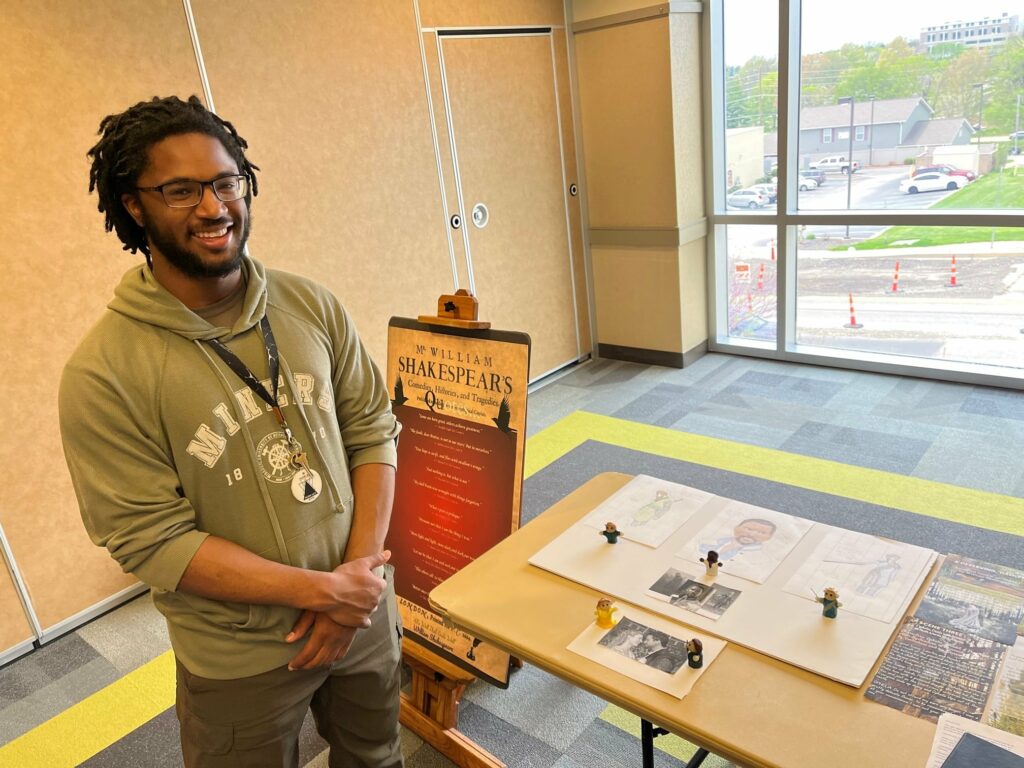
Professor Mathew Goldberg holding books in a library
S&T students publish Southwinds each spring with support from the ETC department. The magazine features creative work by members of the S&T community and remains the university’s only student-run publication.
Graduate student teaching a class
Nhyira Sackey, a graduate teaching assistant in technical communication, teaches ENGLISH 3560 Technical Writing. She completed an internship at Walgreens last summer.
Former S&T student teaching her class
Alumna Kayla Capps (English BA, 2014) teaches 5th grade at Rolla Middle School. "I love teaching in the community I grew up in because I feel like I'm giving back to the community that gave so much to me as a child/young adult."
picture of a Alumna Nora Potrafka
Alumna Nora Potrafka (MS, Spring 2022) works as an embedded writer at Mastercard in O'Fallon, Missouri, bridging technology and communication every day.
ETC major Mia Jaegers working in writing lab helping a student
ETC major Mia Jaegers, a consultant in Missouri S&T’s Writing and Communication Center, works with a geological engineering MS student during a session.
Alumna behind a camera in a classroom
Alumnus Felix Nyikwagh (center, MS, Spring 2024) is now a PhD student at Clemson University, where he merges design, communication, and technology in solving real-world problems.

To Give to the English & Tech Com Giving Days campaign, please click on the “GIVING DAYS” button and complete the following steps: 

  1. From the Giving Days website, click “Make Your Gift Early.”  
  2. Input the amount you would like to give or click the amount.
  3. From the “Select a Designation” dropdown menu, click on "College of Arts, Sciences, and Education” and then select “English and Technical Communication.” 
  4. Input the required information.
  5. Select your payment method of choice.

Why Study ETC?

Missouri S&T’s Department of English and Technical Communication (ETC) offers academic programs that explore the relationship between human communication and emerging technologies. Our students study the power of storytelling through reading, writing, and speaking while learning to communicate complex ideas in a world increasingly shaped by artificial intelligence. Within Missouri S&T’s STEM environment, we are preparing the next generation of teachers, writers, and communicators to think adaptively and act ethically as the communication revolution unfolds. Through our students, faculty, and alumni, we are helping to write the future.

Career Paths for ETC Graduates

ETC graduates build careers across a wide range of communication-related professions. Alumni work as:

  • Technical writers and editors
  • User experience writers and designers
  • Proposal managers and marketing coordinators
  • Strategic communication consultants
  • Teachers and trainers
  • Visual information specialists
  • Business development professionals

Many graduates also pursue advanced degrees and move into leadership roles in industry and academia.

Career Outlook and Industry Demand

Nationwide, media and communication occupations project 104,800 openings per year across roles like technical writers, content creators, and PR specialists​.  Median salaries in these fields are strong, with technical writers averaging around $91,000 per year​.

According to Dr. Kate Drowne, Assistant Provost for Faculty Affairs and professor of English and Technical Communication, “There’s no real limit to what you can do with an English degree because it’s not directed career training. Rather, as an English major you learn the skills for all kinds of environments. You can succeed in any number of fields."

Stay Connected

connect with us on LinkedIn follow us on YouTube follow us on Instagram

ETC in the News